Prioritisation is a leadership habit, not a one-time framework
Most teams treat prioritisation like a meeting.
They schedule it, run a scoring exercise, produce a ranked list — and then don't revisit it until something breaks. The backlog grows. The roadmap drifts. By the time the next prioritisation session happens, half the context has changed and nobody quite remembers why item 7 ever made the top 10.
In product-led growth, this is expensive. Every misaligned bet doesn't just waste a sprint — it slows activation, stalls retention, and delays revenue. In PLG, the product is the growth engine. A bad priority call isn't a planning problem. It's a business problem.
The real issue isn't the framework. It's the frequency.
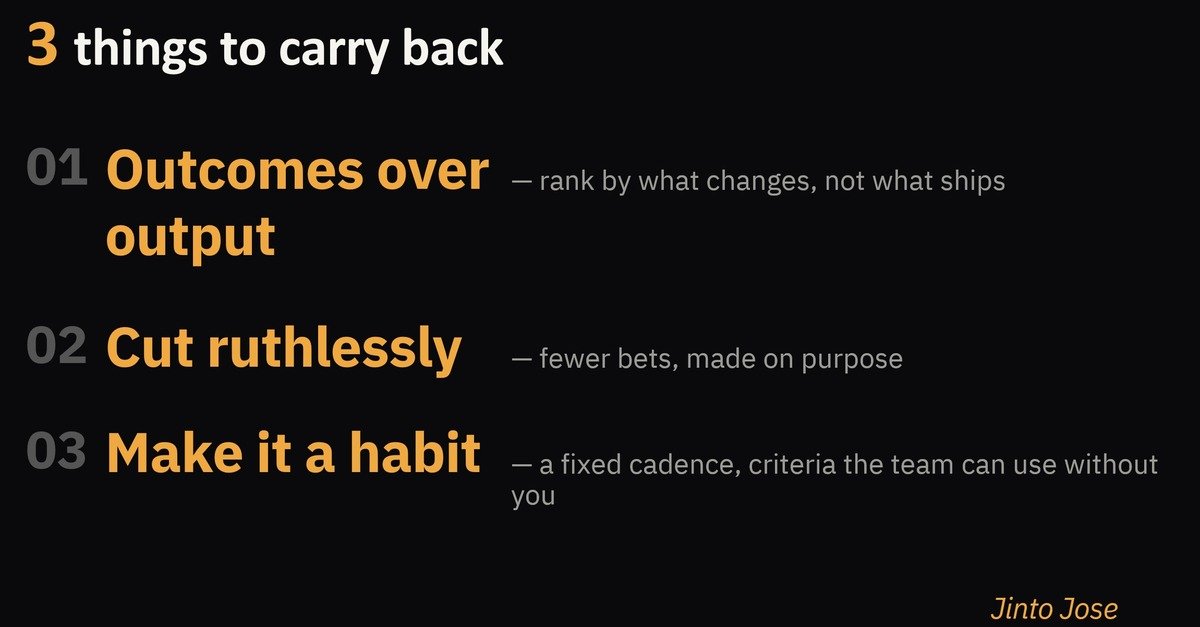
01 · Outcomes over output
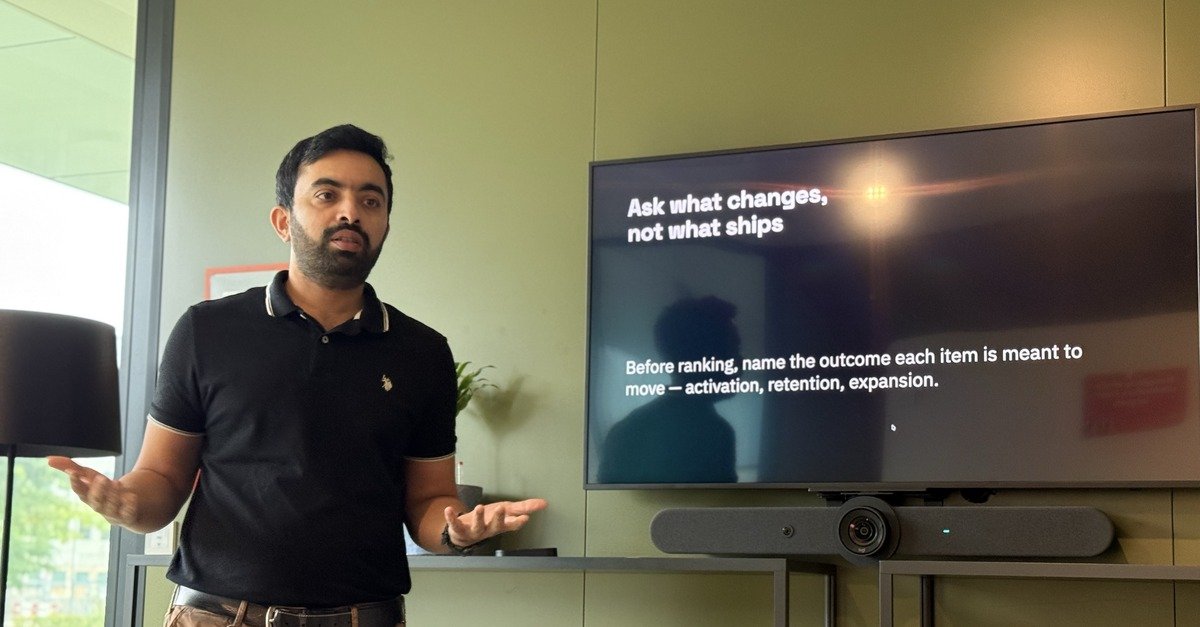
Ask what changes, not what ships.
Output is a proxy. What the team actually gets paid for is the behaviour or metric that changes as a result — an activation rate that moves, a drop in customer effort, an expansion trigger that fires. Shipping is the means. The outcome is the point.
Before ranking anything on your backlog, name the outcome each item is meant to move. Activation. Retention. Expansion. Operational efficiency. If an item can't name its outcome clearly, it goes to the bottom — no exceptions, no "we'll figure it out in planning."
This one discipline alone changes how backlog conversations happen. Suddenly the debate isn't about what's technically feasible or which stakeholder asked first. It's about which outcome matters most right now — and whether this item actually moves it.
02 · Cut ruthlessly
Fewer bets, made on purpose.
A roadmap with forty items is a roadmap with no priorities.
When everything is a priority, nothing is. The team spreads across too many threads, context-switches constantly, and delivers everything slowly rather than the right things fast. In PLG especially, where the feedback loop between product and growth is tight, diffused effort is the enemy.
Cutting isn't failure. Cutting is the decision.
The hardest part isn't identifying what to cut — most teams know what's low-value if they're honest. The hard part is saying no visibly and early, before work has started and sunk costs accumulate. A quiet no just becomes a slow yes. And a slow yes is the most expensive form of prioritisation.
Protect your team's capacity for the bets that actually matter. The discipline to say fewer things means you can say them fully.
03 · Make it a habit
Build the muscle, not the moment.
A framework used once is a slide. Used every cycle, it's a habit.
This is the part most teams skip. They run a prioritisation session, feel good about the outcome, and then let the ranked list gather dust until the next quarterly planning cycle — by which point the market has shifted, customer data has accumulated, and the "top priority" from three months ago is no longer the right call.
The fix isn't a better framework. It's a fixed cadence.
Revisit priorities on a rhythm — not only when a crisis forces the conversation. Make the criteria visible enough that the team can apply them without you in the room. When prioritisation is a shared habit rather than a leader's decision, the organisation gets faster and more aligned at the same time.
That's the goal: a team that doesn't need a meeting to know what matters most.
The leadership line
Here's what I keep coming back to after facilitating sessions like this:
Prioritisation is not a skill you learn once and apply. It's a habit you build deliberately — in how you run planning, in how you push back on stakeholders, in how you create space for the team to make good calls independently.
The three lenses — outcome over output, ruthless cutting, fixed cadence — aren't a checklist. They're a posture. Applied consistently, they change how a product team thinks, not just what it builds next.
Every yes is a no to something else, including the growth lever you didn't fund. Make your yes count.
I facilitated a live breakout session on this at a Product Management community event, with product owners, leads, and tech leads working through a five-item backlog ranking exercise against these three lenses. The conversation in the room confirmed what I've seen repeatedly: most teams know what the right priorities are. They just need the discipline — and the habit — to act on them consistently.
What's the one item on your current backlog that everyone privately knows shouldn't be there?