The work did not disappear. It moved upstream
89% of the scope in my habit-tracker app was built by an agent.
The other 11% took the most thought: pricing, product taste, killing an idea I'd argued myself into, and the paperwork. AI contributed nothing there, on purpose.
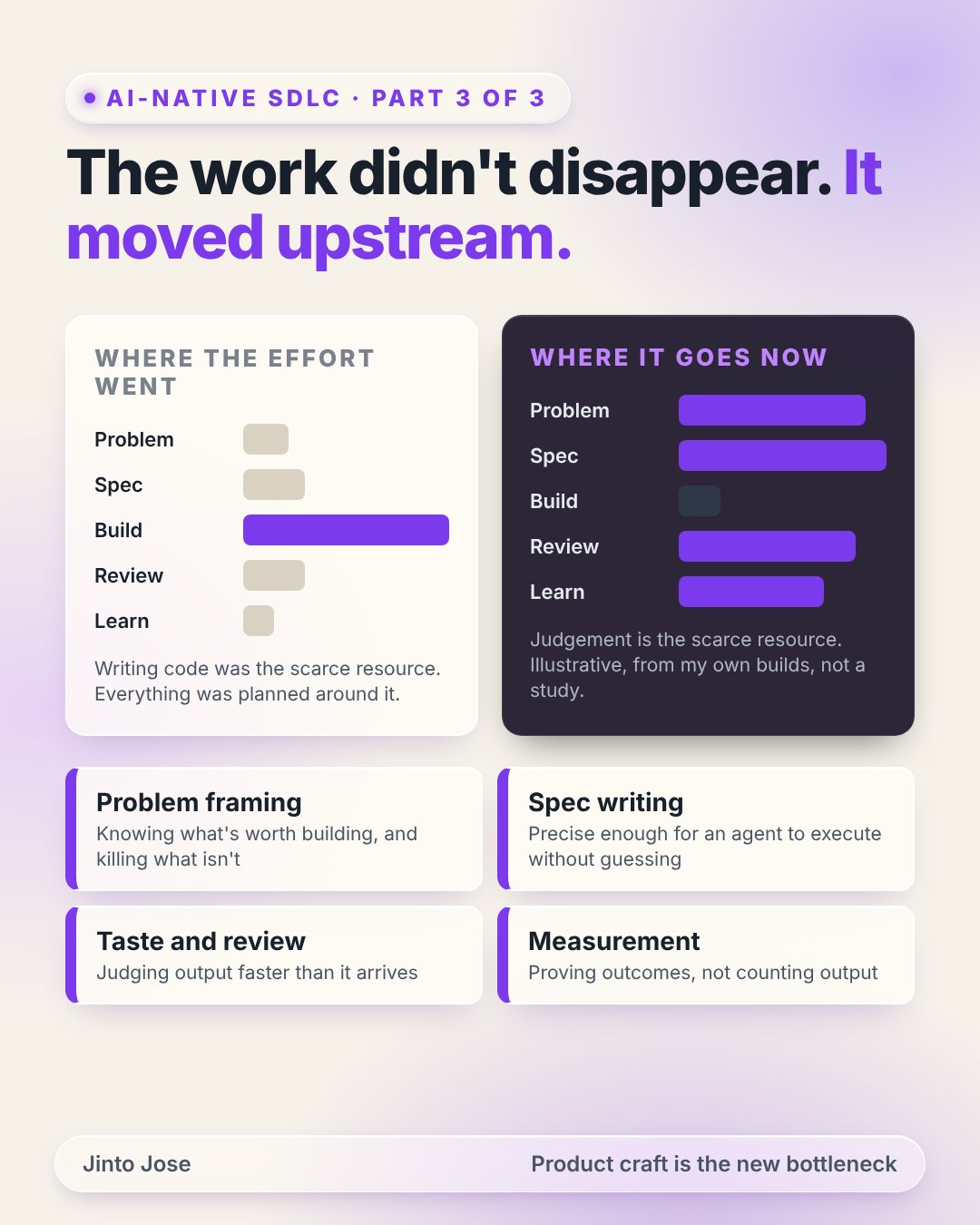
That's the pattern I keep seeing, in my own builds and in every SDLC playbook I read this autumn. The work didn't disappear. It moved upstream, into product craft.
When building is cheap, a vague idea gets built anyway. Fast. So the scarce skills change:
→ framing a problem well enough to know what not to build
→ writing a spec an agent can execute without guessing
→ judging output faster than it arrives
→ measuring outcomes instead of counting output
This is why I think the product lifecycle, not the software lifecycle, becomes the real constraint. Product people who mostly coordinated will feel it first. Those who can grill an idea, write the spec and judge the result will have more leverage than ever.
Fewer hands on the keyboard. A much higher bar for craft.
Part 3 of 3.
Which product skill are you investing in for the next two years?
The whole series, open source:
Part 1, four SDLC playbooks compared: https://github.com/jintomjose/ai-native-sdlc-playbooks
Part 2, my mini software factory: https://github.com/jintomjose/mini-software-factory
P.S. The chart is illustrative, drawn from my own builds, not a study.